
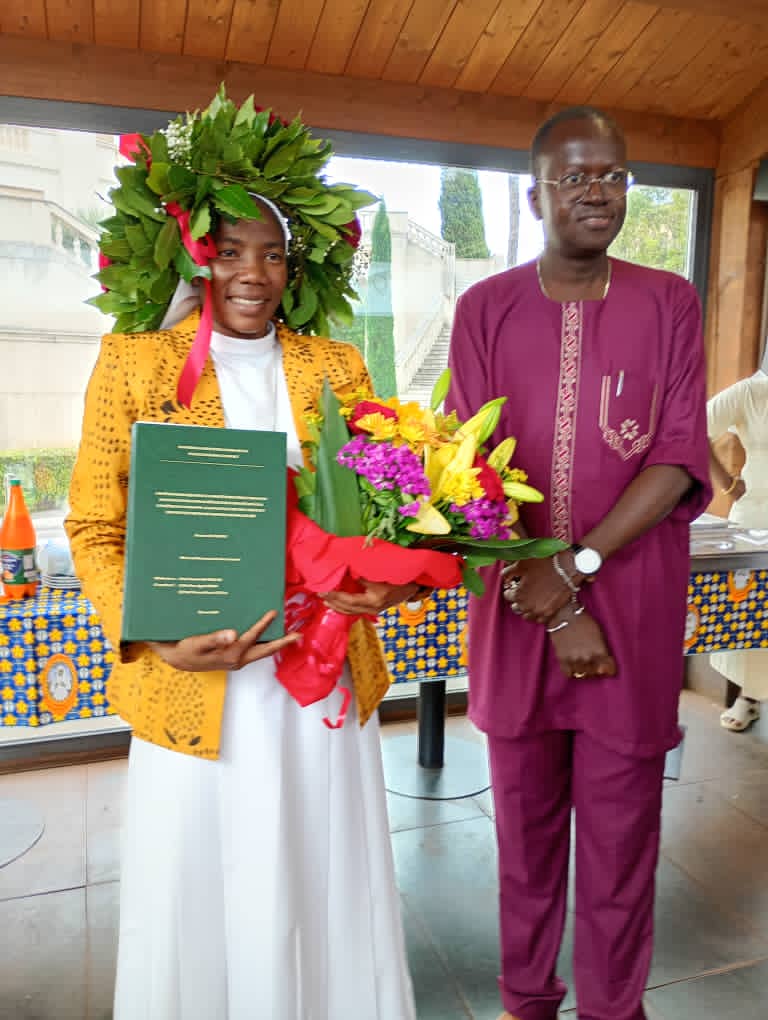
Rome, June 5, 2026, After years of academic and spiritual formation spanning Africa and Europe, Sr. Suzanne Kamano of the Institute of the Little Sisters of Our Lady of Guinea has successfully defended her doctoral dissertation in Canon Law at the Pontifical Urbaniana University in Rome.
The thesis defense took place on Friday, June 5, 2026, marking the culmination of a long journey that began in Guinea, continued through Côte d’Ivoire, and reached its academic fulfillment in Italy.
For the Religious Sister from Guinea (Conakry), the academic milestone represents far more than the completion of years of study. It is the culmination of a journey of faith, obedience, sacrifice, and dedication to the Church, a journey that began in West Africa and reached its academic summit in Rome, at the heart of Catholic scholarship.

Sr. Suzanne’s dissertation, entitled “Juridical Criteria for the Procedure of Erecting an Institute of Consecrated Life of Diocesan Right in the Light of Canon 579: The Specific Case of the Institute of the Little Sisters of Our Lady of Guinea,” examines one of the most significant and timely issues in contemporary canon law: the process by which new Institutes of Consecrated Life are canonically established within the Church.
According to Sr. Suzanne, the choice of this topic arose from a desire to explore the ecclesial and juridical foundations that safeguard consecrated life as a gift of the Holy Spirit to the Church.
She emphasised that the establishment of an Institute is never merely an administrative act but rather the culmination of a lengthy process involving discernment, ecclesial communion, and collaboration among Church authorities, particularly the diocesan bishop and the Roman Pontiff.
“Consecrated life is not a private matter,” she explained. “It is a public gift entrusted to the entire Church. Therefore, its authenticity must be carefully discerned and recognized.”

The research highlights the importance of Canon 579 of the Code of Canon Law and examines recent developments introduced by the Holy See, including the 2016, Rescriptum ex Audientia and Pope Francis’ Motu Proprio Authenticum Charismatis. These reforms strengthen the role of ecclesial communion, collegiality, co-responsibility, and synodality in the process of establishing new Institutes of Consecrated Life.
One of the central conclusions of the dissertation is that the canonical erection of an Institute must always be rooted in the authenticity of its charism and its genuine ecclesial character. Sister Suzanne argues that the involvement of the Apostolic See in this process serves as an essential safeguard against the emergence of isolated or sectarian groups and helps preserve the catholicity and unity of the Church.
The study also stresses the responsibility of diocesan bishops to faithfully implement Canon 579 according to the mind of the legislator. By doing so, bishops ensure that new communities emerge within a framework of ecclesial communion and authentic discernment.
Reflecting on the practical value of her work, Sister Suzanne expressed the hope that the thesis will serve as a useful resource for bishops, canon lawyers, and associations seeking recognition as Institutes of Consecrated Life. She noted that proper adherence to canonical procedures can help prevent the uncontrolled proliferation of communities lacking authentic spiritual foundations.

“The divine gift should never be treated lightly,” she said. “It must be carefully authenticated and approved by the competent ecclesiastical authority.”
Beyond its juridical contribution, the dissertation also reflects a deeply personal journey of faith and perseverance. Sister Suzanne acknowledged that one of the greatest challenges she faced during her studies was learning the Italian language, a difficulty compounded by the fact that many of the sources necessary for her research were written in Italian and other unfamiliar languages.
Nevertheless, she views these challenges as an integral part of both academic and spiritual growth. “No meaningful work can be accomplished without difficulties,” she reflected. “Like a mother who gives birth through pain that is transformed into joy, every worthwhile achievement requires sacrifice.”
For Sr. Suzanne, academic study is more than an intellectual pursuit; it is fundamentally an act of obedience and service. She believes that knowledge should never become a means of self-promotion but rather a way of deepening one’s understanding of the mystery of God and serving the Church with humility.
“The purpose of study is not to gain prestige,” she stated. “It is to contemplate a reflection of God’s mystery, to live it, and to teach it first through actions and then through words.”

Her message to young religious and future scholars is one of authenticity, humility, and perseverance. She encourages them to cultivate their talents without losing their identity or seeking recognition, remembering that true service often flourishes in silence.
“In a noisy environment,” she concluded, “silence speaks more powerfully than words.”

Looking ahead, Sister Suzanne intends, with the grace of the Holy Spirit, to publish her doctoral dissertation and make its findings available to a wider audience. Any future academic projects, she says, will remain entrusted to the discernment of her religious superiors and the needs of the Church.
Her work stands as a valuable contribution to the ongoing reflection on consecrated life and ecclesial communion, while also serving as a testimony to the dedication, faith, and perseverance required in the pursuit of both academic excellence and religious vocation.
Sr. Patricia Akoto, FST (Catholic Sister Communicators Network-GH)