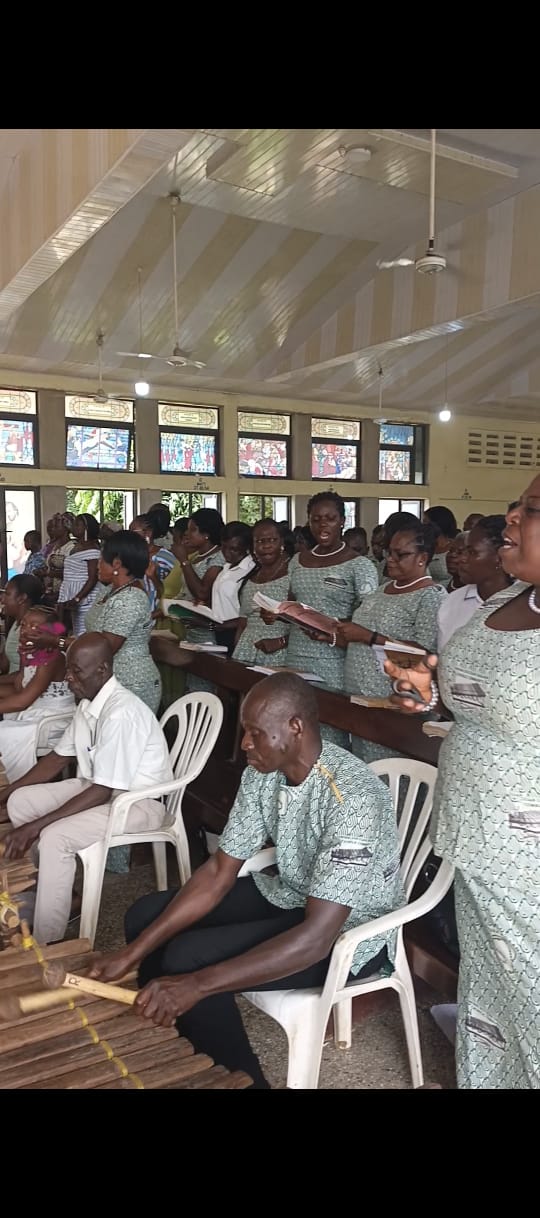


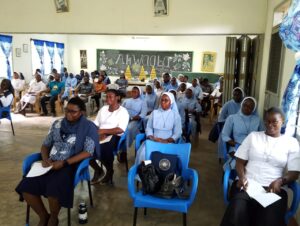
On June 6, 2026, there was a good representation of the temporary professed Sisters at a Seminar facilitated by the Most Rev. Matthew Kwasi Gyamfi, Bishop of the Catholic Diocese of Sunyani and the President of the Ghana Catholic Bishops’ Conference.
The Seminar was held at the Holy Spirit Sisters Novitiate at Dumasua in the Catholic Diocese of Sunyani, Bono Region of Ghana, under the topic, A call to Communion: Living a balanced life of prayer, Community and Ministry.
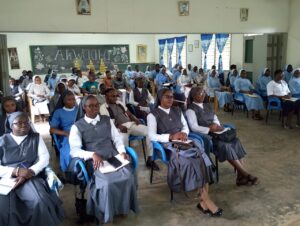
It was organised by the Religious Formators as part of the ongoing formation programmes for Religious Brothers and Sisters in the Sunyani sector who are under temporary vows. Although, the Seminar brought both Brothers and Sisters together, the participation of Sisters was particularly noteworthy. Out of 57 participants, 45 were Sisters, while only 12 were brothers.
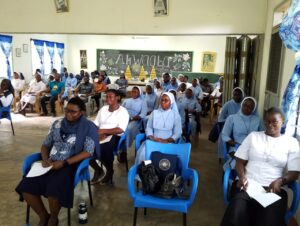
These 45 Sisters represented the following Congregations: Handmaids of the Holy Child Jesus (HHCJ), Sisters of the Incarnate Word (SVI), Oblate Sisters of the Holy Spirit (OSS), Religious Sisters of the Blessed Virgin Mary (RVM), Medical Mission Sisters (MMS), Holy Cross Sisters (CSC), Sisters of the Holy Family of Nazareth (CSFN), and Missionary Sisters of the Holy Spirit (SSPS).
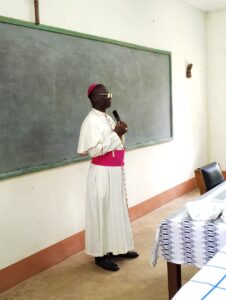
The 12 Brothers represented the following congregations: Salesians of Don Bosco (SDB), Holy Cross Brothers (CSC), the Order of St. Benedict (OSB), and Brothers of the Immaculate Conception (FIC).
To kick off the session, the Bishop briefed the participants on the history of religion, explaining that the roots of Religious Life could be traced back to the early Christian, saying that during that time, believers eagerly anticipated Christ’s second coming, convinced it would happen soon and consequently, they prepared for His arrival by withdrawing to the desert to pray.

However, as time passed without His anticipated return, they encountered increasing challenges, the Bishop stated, adding that recognising the difficulties of solitude, they decided to come together and share their lives.
This decision marked the beginning of religious life, Bishop Gyamfi noted.
“Religious life is not a creation of the clergy; it is a creation of the lay faithful,” he emphasised, explaining that community life forms the foundation of the vows professed by religious individuals.
Additionally, he noted that the gathering of these hermits necessitated the establishment of basic rules to guide them, which later evolved into the constitutions we have today.
In his presentation, Bishop Gyamfi acknowledged that community living is the most challenging aspect of religious life. He urged the brothers and sisters to remain committed to their community, believing that those who separate themselves will encounter serious problems.
He emphasised that a religious person should find joy within the community, asserting that anyone who finds happiness elsewhere is not truly living a religious life.
He cited various instances in the life of Christ where he communes with people and shows them love, advising his audience to be fully present in their communities, going beyond the physical but mentally and spiritually present in the community. For he says that some may be afraid to accept the love of others, which makes them lonely even in the midst of many.
“The community is our strength, the community is where we pray for and are prayed for,” he added.
Bishop Gyamfi exhorted the Religious Brothers and Sisters never to let their apostolate take precedence over their prayer life, with the notion that the lord will understand the nature of their work.
He stressed the importance of prayer as he noted that the basic reason of their call is to be with Jesus in prayer and that it is not the apostolate that makes them religious. The Sunyani Bishop lamented over this while noting that it is a big mistake that most religious make, by placing more priority on their apostolate over their prayer life, advising the temporally professed to desist from such behaviour.
He echoed that it is in prayer that a religious is given the energy to go out and serve, and that apostolate is a temporal thing in religious life because one’s apostolate can change at any time.
He admonished the participants never to use tiredness as a yardstick to exempt themselves from prayer.
Therefore, he advised the Religious Brothers and Sisters not to live a life based on some people’s opinions but to be committed to living a life well-versed in Christ, with Christ as their focal point, and to desist from unnecessary competitions and comparisons.
He further noted that individuals are called into the Religious Life and made Saints in the Church, not a congregation. And so, he admonished his audience to stop hiding behind their congregation while claiming a particular identity and to develop a personal relationship with Christ.
He noted that he or she who can relate with Christ within the congregation is the one who can walk as a saint, for he explained that the congregation provides the parameters that you can easily become a Saint.
Drawing the curtains to a close, Bishop Gyamfi admonished the young Religious to be good brothers and sisters, and if one is really a Religious Sister, Brother, or Priest, he or she knows, for they cannot cheat God or themselves, adding that the church wants good Religious Brothers, Sisters, and Priests.
By Sr. Esther Kutie, SVI (Catholic Sister Communicators Network, CASCON-GH)